Can a machine hear how you're doing?
That's roughly what my bachelor's thesis asked. I built interpretable speech emotion recognition models at Björn Schuller's Chair of Health Informatics at TUM, and got the top grade, 1.0, for the answer. The longer version would be a master's in computer science at TUM. Unless the right full-time role comes first.
Looking for A working student role from January 2027.
Background
Race and Test Operations department. Internal application management for 250+ users: tendering, approval workflows and vendor management, currently a VDI rollout for trackside IT.
Focus on machine learning, deep learning and data analytics. Thesis submitted February 2026, graded 1.0.
Tools
- Python
- PyTorch
- Swift
- React Native
- Firebase
- SQL
- Docker
- Git
- Linux
- Claude Code
- MCP servers & skills
Projects
Die Projekte sind auf Englisch, wie die Fachbegriffe darin.
01
Interpretable Speech Emotion Recognition
Bachelor's thesis
Audio and text models for emotion recognition, built to stay interpretable.
Interpretable Speech Emotion Recognition
Bachelor's thesisCombined audio and text models (Wav2Vec 2.0, BERT) for interpretable emotion recognition, comparing several architectures including a cross-modal transformer and a custom domain model. Feeding one predicted intensity value into the decision fixed a quarter of the cases where happy speech was read as neutral, and beat the far heavier transformer. Graded 1.0, the top grade, at Björn Schuller's Chair of Health Informatics at TUM.
Words · what was said
Voice · how intense
Merged · intensity gate
Low intensity → neutral
High intensity → happy
02
Acoustic Markers of ADHD
A TUM team project on parent-child dialogues. I built the classification pipeline.
Acoustic Markers of ADHD
A clinical team project at TUM analysing parent-child dialogues for acoustic markers of ADHD. I built the classification pipeline and extracted the acoustic features with eGeMAPS. The clearest pattern was temporal: the children's voices drifted further apart from the control group the longer each conversation ran, while the parents' stayed put.
How far apart the two groups sound
Children
Gap keeps growing
Parents
Gap stays flat
03
Applied Machine Learning
Lab course
ML methods written from scratch, not imported from a library.
Applied Machine Learning
Lab courseA solo lab course at TUM. Regression, classification, KNN, K-Means and matrix factorisation implemented from the maths up rather than called from scikit-learn, with regularisation, cross-validation and hyperparameter tuning around them. Graded 1.0.
View on GitHub
04
mockframe
One command, or one sentence in Claude Code, turns an app screenshot into a rendered device image.
mockframe
A command line tool that turns an app screenshot into a rendered device image. The housing is generated procedurally from millimetre measurements and shaded by its own software rasteriser, so it needs no 3D assets and no GPU.
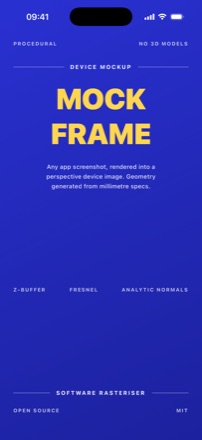
$ uvx mockframe render today.png --auto-device
“make me a hero image”
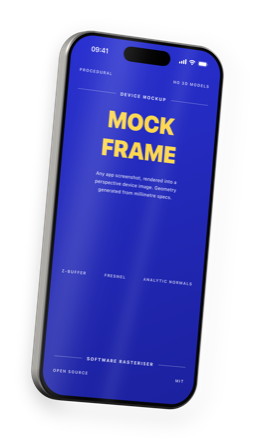 Screenshot in
One command, either way
Device image out
Screenshot in
One command, either way
Device image out
05
KLAR
In progress
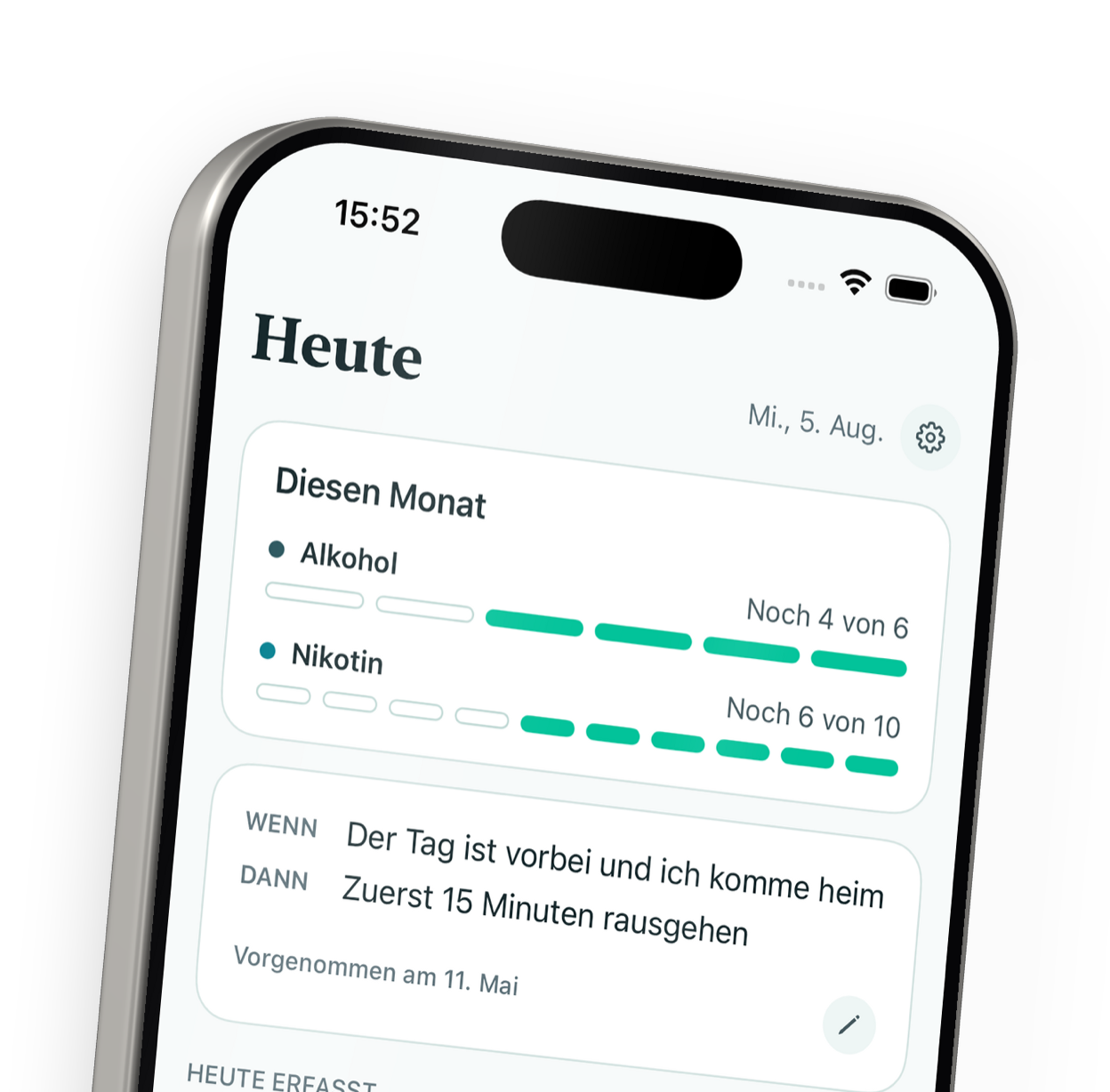
Substance-use reduction on iOS, with nothing leaving the device.
KLAR
In progressA local-first iOS app for substance-use self-monitoring and structured reduction. The feature set comes from the behaviour-change literature rather than from a feature list: self-monitoring alone barely shifts consumption, and the Drink Less factorial trial found an effect only where logging was paired with if-then action planning, so KLAR is built around that pairing. Everything stays on the device, with no account and no backend, so health data never leaves the phone.